RVs, Trailers, Fifth Wheels, and Campervans almost always have the ability to connect to utility power. And almost all of them have either a 30 amp or 50 amp service connection.
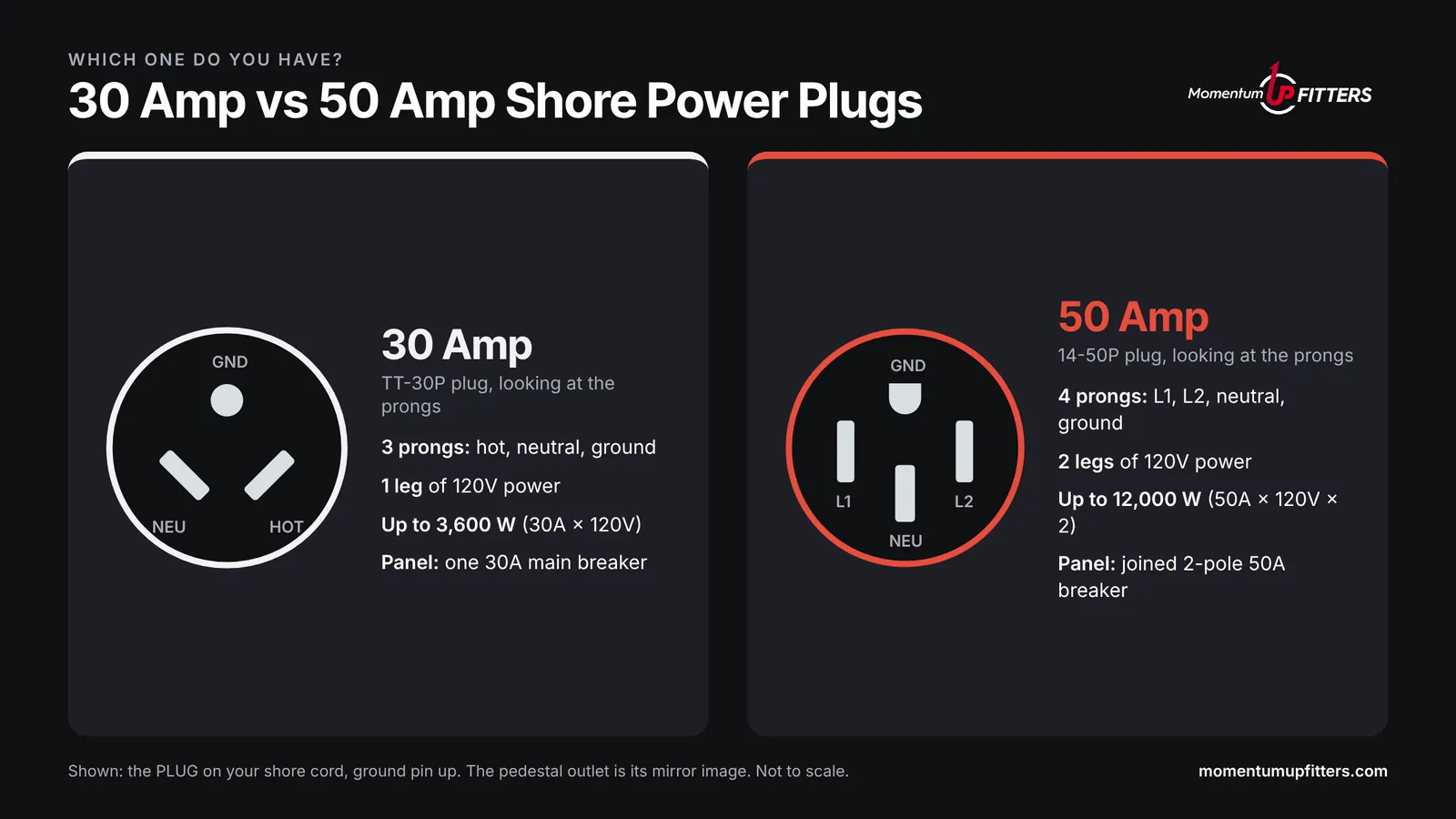
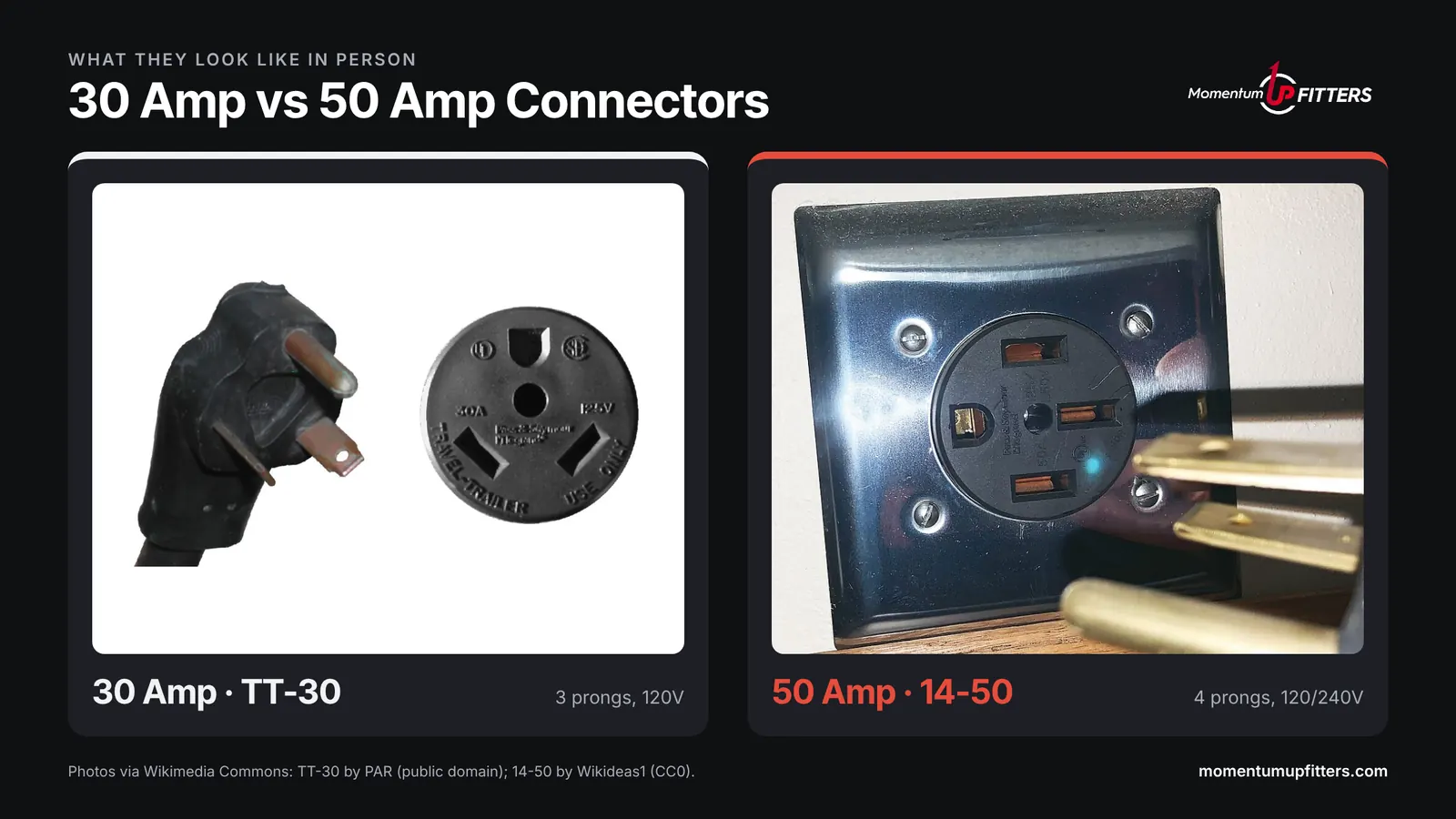
You can easily tell which one you have by looking at the plug at the end of your shore power cable, or at your power distribution panel. Refer to the image above to see which type you have.
The difference in available power is bigger than the numbers suggest. A 30 amp service gives you one 120V leg, or about 3,600 watts. A 50 amp service gives you two 120V legs at 50 amps each, or about 12,000 watts. That is more than three times the power, which is why larger RVs with two air conditioners are built for 50 amp service.
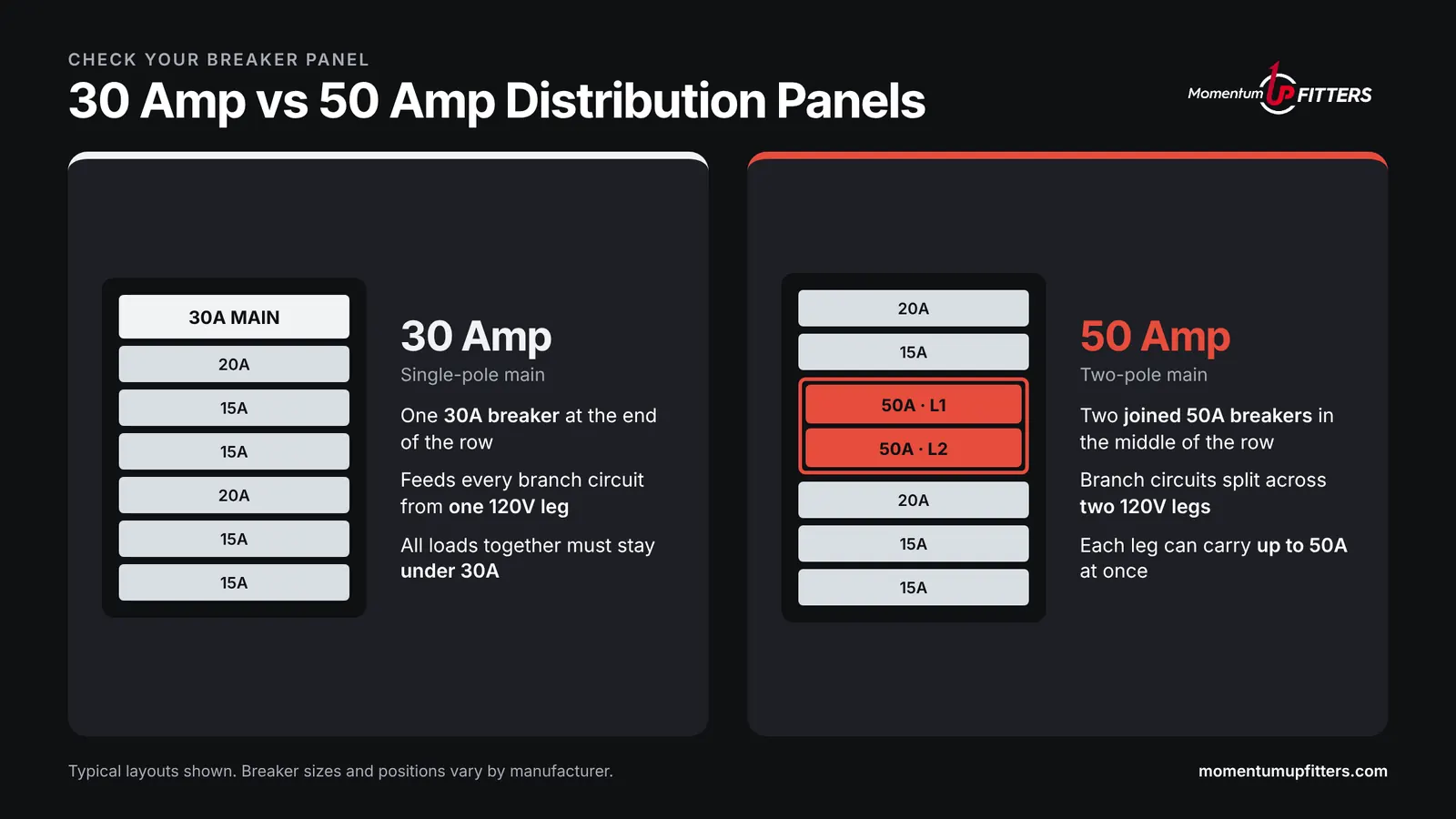
Likewise, a 30 amp service will have a power distribution panel that has one 30 amp breaker at one end of the row of breakers, and a 50 amp panel will have two joined 50 amp breakers in the middle of the row of breakers.
Twist-Lock Shore Power Inlets
Many RVs with a detachable shore cord have a twist-lock inlet on the side of the coach instead of a fixed cord. On a 30 amp RV this is usually an L5-30 style inlet with three curved blades. On a 50 amp RV it is usually an SS2-50 style inlet with four curved blades. The cord locks in with a quarter turn, and most have a threaded collar that keeps out water and dirt. The other end of the cord still uses the standard TT-30P or 14-50P plug shown above.
30 Amp Service – 1 Pole
30 amp service is very simple, consisting of three wires, live, neutral, and ground. Residential power in North America can get complicated, but I’ll try to keep this as simple as possible.
Current flows between the live and neutral wires, and the total current used by every device connected to the AC power system must be less than 30 amps.
50 Amp Service – 2 Poles
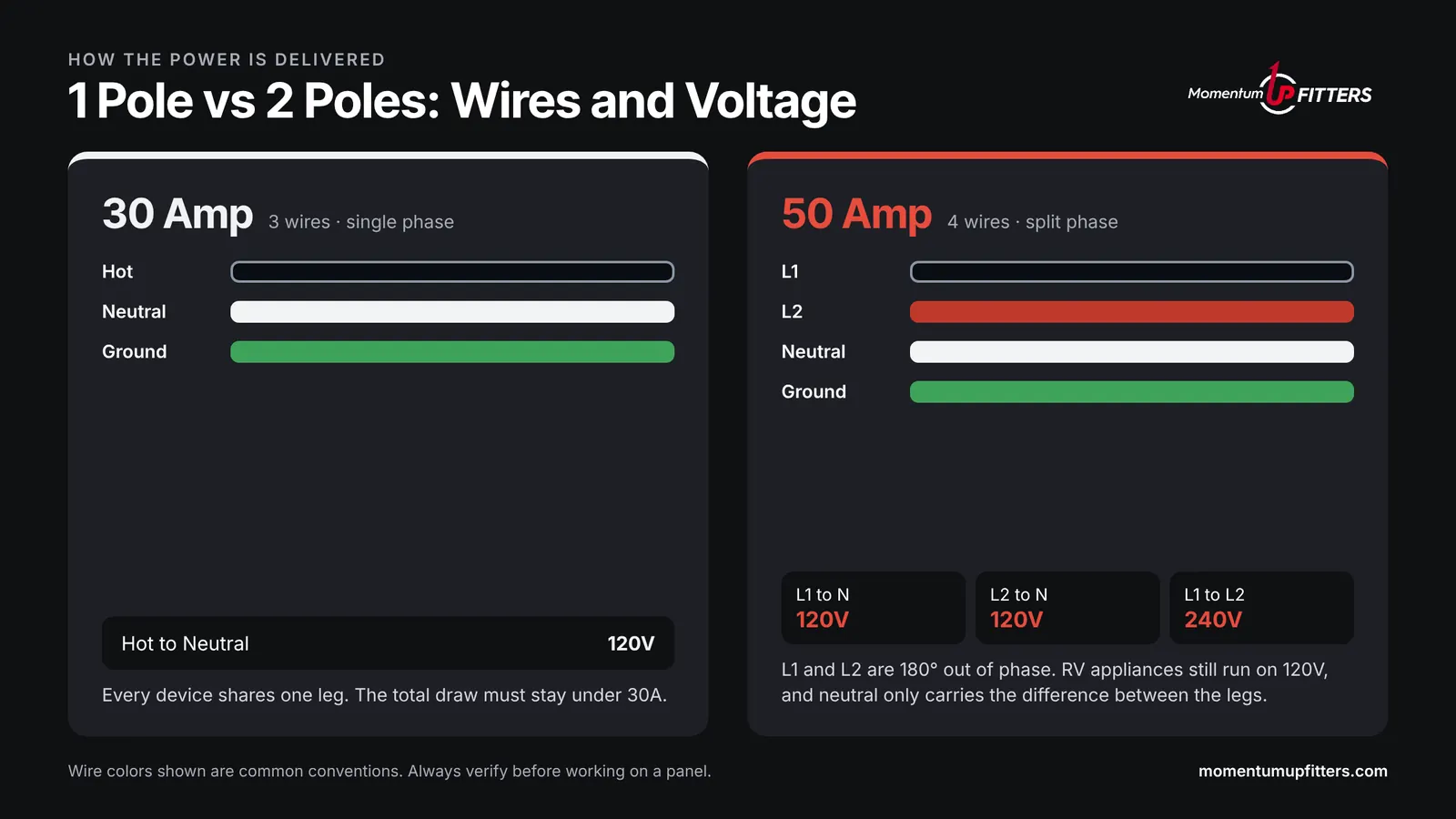
Now where things get a little bit tricky is 50 amp service. This type of service has two power poles, we’ll call them L1 and L2, as well as neutral and ground. If you measure between L1 and L2 you will see 240V, but almost every RV appliance runs on 120V, between one leg and neutral.
Power still flows between L1 and Neutral and L2 and Neutral, but since L1 and L2 are 180 degrees out of phase, we can have 50A flow through L1 and 50A flow through L2 at the same time. As an example, if at any given instant there is 10A flowing through L1, and 10A flowing through L2, since L1 and L2 are perfectly out of phase, that means that 10A must flow into neutral from L1, and 10A must flow out of neutral into L2. This means that the maximum current through neutral is 50A, and can only be reached if one live leg is drawing 50A and the other live leg is drawing nothing.
Since 50A service in RVs still only uses 120V appliances, a single 120V inverter can power the entire coach by feeding both L1 and L2. The catch is that both legs are now in phase, so the neutral carries the combined current of both legs instead of the difference. That means the inverter must not be able to supply more than 50 amps, or about 6,000 watts. This keeps the neutral within the rating of a 50 amp system.
Can You Plug a 50 Amp RV Into 30 Amp Service?
Yes, and the reverse works too. Campgrounds don’t always have the service your RV was built for, so adapters (often called dogbones) let you connect anyway. Each direction works a little differently.
50 amp RV on a 30 amp pedestal
A 30-to-50 adapter connects the single 30 amp hot to both L1 and L2. Everything in the RV still works, but the whole coach now shares 30 amps, or about 3,600 watts. In practice that usually means running one air conditioner and keeping an eye on the microwave, water heater, and other large loads. The pedestal’s 30 amp breaker protects the system, so if it trips, you are asking for more than the service can give.
30 amp RV on a 50 amp pedestal
A 50-to-30 adapter takes power from one leg of the 50 amp outlet. Your RV still has its full 30 amps, and its own 30 amp main breaker protects it. This is a safe and common setup.
One connection to avoid
Never plug a 30 amp RV into a 30 amp dryer outlet at home. Dryer outlets supply 240V, and a homemade adapter can send 240V into 120V equipment and damage it. A TT-30 RV outlet is 120V only.
Where many 50 amp inverter installations go wrong
Most readily available inverters or inverter/chargers create single-phase 120V power. Since 50 amp service uses two legs, sometimes inverters may be used to energize only one leg of the system, which means that only about half of the circuits are energized. In some trailers this can be OK, but for most it is not desirable.
What I’ve seen done from time to time is the installation of two inverters. This is potentially dangerous. Most inverters for campers or off-grid systems do not have the ability to synchronize their output, as such, you will have two 120V AC power sources that are at some unknown phase relative to one another, and isolated from one another.
For instance, imagine you’re using two 5 kVA inverters, and they happen to be completely in phase, and connected via L1, L2, and Neutral. What will happen if you draw the maximum power, around 42 amps, on each inverter? L1 will see 42 amps, which is fine, L2 will see 42 amps, which is also fine, however Neutral will see 42+42=84 amps. Normally such a condition would not be possible, since L1 and L2 are each protected by a 50 amp circuit breaker, and the neutral current is only equal to the difference between the current on L1 and current on L2. Since L1 and L2 are in phase now, the current in neutral is equal to the sum of the currents on L1 and L2. This leads to an overcurrent on neutral, and in the worst case, could cause a fire!
Many installations use 3kVA inverters, which are capable of a maximum of 25 amps. These are typically safe for this application, since they can not produce more than ½ the maximum rated current.
50 Amp Inverter layouts
So, while 50 amp systems are a little bit more complicated than 30 amp systems, they can still be connected relatively easily to an inverter, or inverters. As discussed above, there are several inverter system options available for 50 amp campers.
Dual Inverters
One inverter for each leg is viable, so long as each inverter does not exceed 3 kVA. Units with a built in transfer switch are typically suitable for this application, but be sure that no more than one unit is charging batteries from utility power at a time. Victron’s 120V inverter/chargers in this size, such as the MultiPlus-II 12/3000/120 and the MultiPlus-II 24/3000/70, fit this layout well.
Single Inverter
A single inverter can also be used to power the entire system, since all appliances are still only 120V. A single inverter solution requires an external transfer switch designed to switch both poles & neutral.
Purpose Built Inverters
Victron makes 2x120V inverter/chargers built for exactly this job. They connect to 120/240V split phase shore power, handle up to 50 amps on each leg, and combine the inverter, charger, and transfer switch in one unit, so there is no external transfer switch to add. The MultiPlus-II 12/3000 2x120V, MultiPlus-II 12/4000 2x120V, and MultiPlus-II 24/3000 2x120V cover most 50 amp RVs. Our post on the MultiPlus-II 12/4000 covers what the newest one changes. The Quattro-II 12/3000 2x120V and Quattro-II 24/3000 2x120V add a second AC input, so they can switch between shore power and a generator on their own.
These units have a lot of settings and pair with a wide range of Victron monitoring and charging gear. That flexibility is a strength, and it rewards careful system design and setup.
Get Help With Your RV Power System
Momentum Upfitters designs and installs inverter systems for both 30 amp and 50 amp RVs, from single inverter setups to complete Victron 2x120V systems. We size the system to how you camp and wire it so both legs and the neutral stay within their ratings.