
For years, the biggest 12V MultiPlus-II was the 12/3000. The name says 3000, but that is volt-amps. The real output is 2400W. So when a customer with a 12V rig wanted to run an air conditioner and a microwave at the same time, I had two answers: add a second inverter/charger, or rebuild the system at 24V. Both options add cost and complexity. The second inverter/charger also adds weight and takes up space.
Victron now has a third answer. The MultiPlus-II 12/4000/160-50 is the most powerful 12V MultiPlus-II they make, and it comes in both a 120V version and a 2x120V version for 50 amp RVs. We have both on our store, and we have built it into many of our 2027 Complete RV Power Packages, which we will release soon.
I think it is the most useful Victron release for RV owners this year. The most exciting release would be a 5000VA 2x120V, and that one is still on my wish list. The 12/4000 gets us closer.
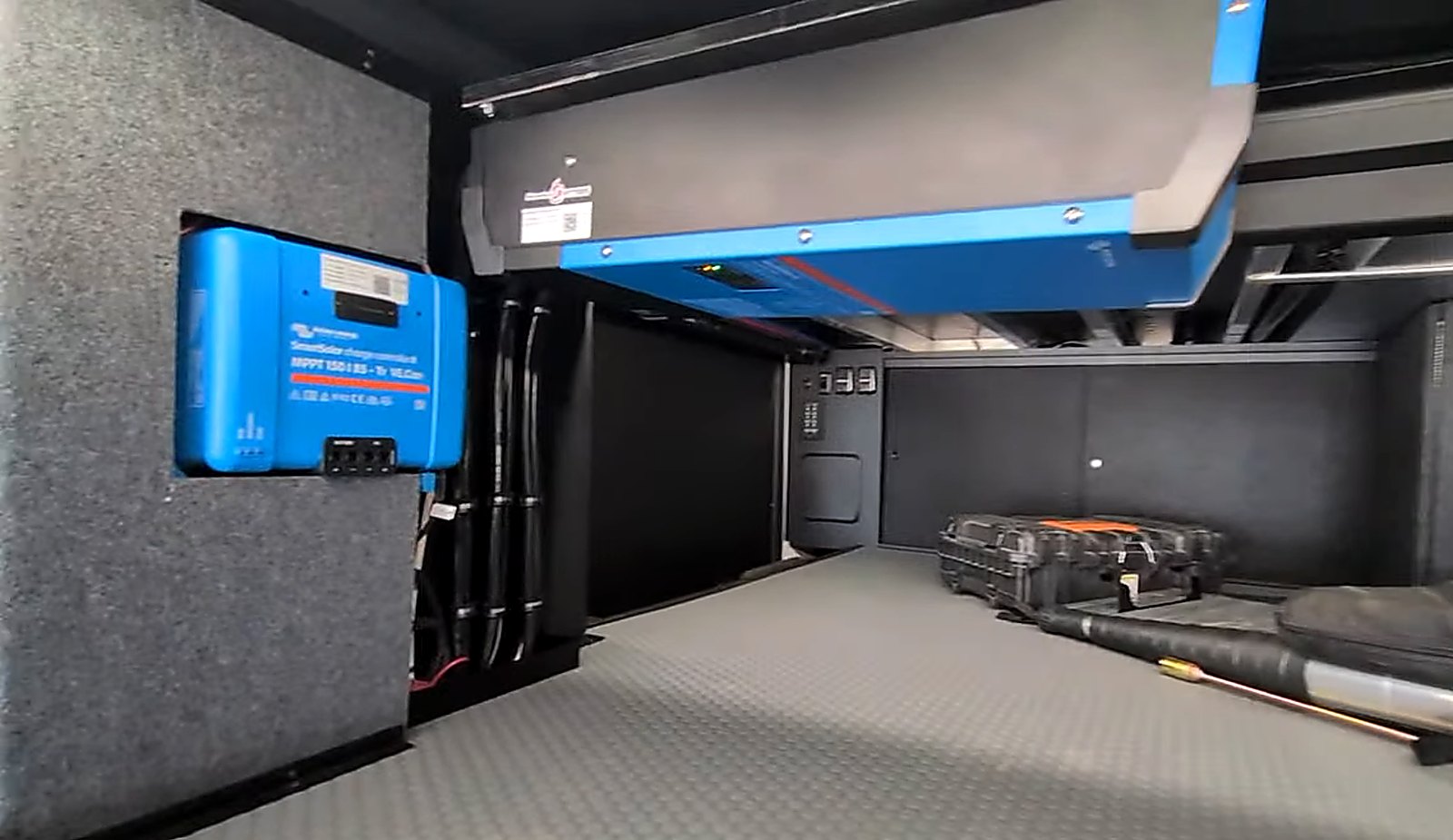
Our first installation of the 12/4k in a Brinkley Model GX, replacing the factory 12/3000.
What an Inverter/Charger Does
An inverter/charger combines an inverter, a charger, and a transfer switch in one box. The inverter turns 12V battery power into 120V household power. The charger refills the batteries from shore power or a generator. The transfer switch moves your outlets between shore power and battery power on its own, fast enough that most electronics never notice.
The Numbers That Changed
| MultiPlus-II 12/3000/120-50 | MultiPlus-II 12/4000/160-50 | |
|---|---|---|
| Continuous output at 77°F | 2400W | 3400W |
| Continuous output at 104°F | 2200W | 3100W |
| Short-term output from a cold start | Not rated | 4000W for 1 hour, 4500W for 30 minutes |
| Peak output | 5500W | 6000W for 2 seconds |
| Battery charger | 120 amps | 160 amps |
| Transfer switch | 50 amps | 50 amps |
| Idle power draw | 13W | 18W |
| Size (H x W x D) | 22.7 x 10.9 x 5.8 in | 24.8 x 10.9 x 6.5 in |
| Weight | 42 lb | 49 lb |
| Recommended DC fuse | 400 amps | 600 amps |
Specs are from Victron's manual for the 120V models. The 2x120V version has the same inverter and charger ratings.
1000W more continuous power. 3400W is about 40% more than the 12/3000. A rooftop air conditioner and a microwave each draw around 1500W while running. Together they are too much for 2400W. They fit inside 3400W.
Extra power for the first hour. Starting cold, the 12/4000 can hold 4000W for an hour or 4500W for 30 minutes. That covers the times you stack loads for a while, like cooking dinner with the A/C on.
A 160 amp charger. That is a third more than the 12/3000. On a 400Ah lithium bank, it means roughly two and a half hours from empty to full on shore power or a generator, instead of more than three. That means less generator time.
A rating in watts. Victron is moving its inverter/chargers from volt-amp ratings to watt ratings. I am glad. "3000" that means 2400W has confused buyers for years. The "4k" in this model name is not the continuous number either. Plan around 3400W.
What Did Not Change
The peak rating barely moved, from 5500W to 6000W. If your only problem is an air conditioner that will not start on the inverter, this is not a big step up. A soft start cuts the surge when the compressor kicks on. A high-efficiency air conditioner with a variable-speed compressor goes further. It ramps up gently, with almost no startup surge, and it uses less power the whole time it runs. That leaves more of the inverter for everything else.
The transfer switch is still 50 amps. Output still drops with heat, to 3100W at 104°F and 2400W at 150°F, so a sealed compartment in July gives some of that extra power back. We plan for airflow on every install.
Two Versions: 120V and 2x120V
The MultiPlus-II 12/4000/160-50, 120V is for 30 amp RVs, vans, and trailers. One 120V line comes in and 120V goes out.
The MultiPlus-II 12/4000/160-50, 2x120V is for 50 amp RVs. A 50 amp pedestal supplies two 120V lines, and this version passes both through to your panel. On battery power, it ties the two sides of the panel together so every 120V circuit stays live from one inverter. Our guide to 30 amp vs 50 amp RV service explains the difference.
On the 2x120V, the 3400W is shared across the whole panel, not 3400W per side. It also does not make 240V from the batteries, so a 240V dryer only runs on shore power or a generator.
12V Current: Batteries, Cables, and Fuses
At 3400W, a 12V inverter pulls close to 300 amps from the batteries. During the 4500W window it is closer to 400. The battery bank, the cables, and the fuses all have to be sized for that current.
- The battery bank. Victron recommends 400Ah to 1200Ah. With lithium batteries, look at the discharge ratings too. Most rigs do not run at full continuous output for long. The big loads come in bursts: a microwave for five minutes, an induction cooktop for fifteen. So a bank rated for, say, 400 amps for 10 minutes and 250 amps continuous is still a workable match. That bank can cover the peaks. It cannot feed the inverter at full output hour after hour. A SmartShunt or a Cerbo GX shows the amps you are pulling in real time, so you know where you stand.
- The cables. The 12/4000 needs more copper than a single 4/0 cable can provide, which is the largest size most shops stock. Victron's manual calls for two 2/0 cables per terminal on runs up to 16 feet, and two 4/0 cables beyond that. The 12/3000 is different. Its manual calls for two 1/0 cables, which adds up to the same copper as one 4/0, so a single cable can do the job. With the 12/4000 there is no way around doubling up. Our Victron DC wire and fuse size chart lists the sizes for every model.
- The fuses. Victron's manual lists a 600 amp fuse, up from 400 amps on the 12/3000. When we run two 2/0 cables, we recommend two 300 amp fuses instead, one on each cable. That way each cable is protected on its own. The inverter fuses go in a Lynx Distributor. The battery bank gets its own protection upstream: a Class T fuse, a fast-acting type built to stop the very high current a lithium battery can deliver in a short circuit. The Lynx Power In, Class T holds that fuse on the battery side.
If you are swapping a 12/3000 for a 12/4000, expect new cables and new fuses along with the inverter. It is not a drop-in swap. The unit is also two inches taller and almost an inch deeper, so check the space. And like every MultiPlus-II, it has to be programmed for your batteries and shore power. That takes a VE.Bus to USB MK3 Interface.
Who Should Buy It
The 12/4000 is a good fit if:
- Your rig is already 12V and 2400W is not enough.
- You want to run an air conditioner plus a second large appliance from batteries.
- You run a generator to charge and want to shorten that time.
- You have a 50 amp RV and want one inverter to power the whole panel.
The 12/3000 is still the right call if:
- Your loads fit inside 2400W. Most rigs with one air conditioner do.
- Your battery bank is under 400Ah.
- Space is tight.
We carry the 12/3000 in both 120V and 2x120V versions.
Look at 24V or 48V if: you are building a large system from scratch. The same power at 24V takes half the current, which means smaller cables and less heat. For a new build with heavy loads, I would still start there.
The higher-voltage lineup has gaps, though. The 4000 model is 12V only. There is no 24V version. At 24V, you choose between the 24/3000 at 2400W and the MultiPlus-II 24/5000, a larger and heavier unit. The 2x120V versions also stop at the 24/3000. There is no 48V 2x120V at all, so a 50 amp RV at 48V needs a different approach, such as two inverter/chargers.
The 12/4000 is the most powerful 2x120V inverter/charger Victron makes, and it changes the answer for rigs that are already 12V and should stay that way.
For help working out how much power you need, see our guide on choosing an off-grid system. Our inverter/charger sizing guide compares every model.
My Take
This is the inverter I wish Victron had made five years ago. It closes the gap between "one 3000 is not quite enough" and "rebuild everything at 24V." It is not a casual upgrade, because the cables, fuses, and batteries have to match it. Sized correctly, it gives a 12V rig about as much power as a 30 amp shore connection.
We are an authorized Victron dealer and installer in Salt Lake City and Fort Collins. If you want help deciding between the 12/3000 and the 12/4000, tell us about your rig and what you want to run. Get a Quote